I found this very interesting video on Youtube that shows the whole process of mining white sapphire.. all the way to polishing and facetting as a gem!
Extremely educational.. something that is so behind the scenes, I would even say, unglam, of the gem stone industry!
Enjoy!
Showing posts with label minerals. Show all posts
Showing posts with label minerals. Show all posts
Saturday, June 20, 2009

Thursday, June 18, 2009
Opal specimen
A nice specimen of boulder opal from Australia..
Can take a look at the rich colours beneath the iron stone surface..
 The reverse of the pebble reveals a nice bluish tone...
 I simply love opals..
Can take a look at the rich colours beneath the iron stone surface..
 The reverse of the pebble reveals a nice bluish tone...I simply love opals..
Friday, April 17, 2009
Black Phantom Quartz Crystals
These double terminated quartz crystals look so common...

But on closer look, one realises that the black colour is not solid and is actually caused by the inclusions in the stone!

 This piece is more unique... almost a sceptre:

But on closer look, one realises that the black colour is not solid and is actually caused by the inclusions in the stone!

 This piece is more unique... almost a sceptre:
Thursday, April 16, 2009

Wednesday, April 15, 2009
Potch Opal
Ilove the colour on this piece of raw potch opal.
Potch opal refers to hydrated silicon dioxides without the play of colour.
 Even without a play of colour, this raw piece of potch opal still has a beautiful greenish-blue.
Potch opal refers to hydrated silicon dioxides without the play of colour.
 Even without a play of colour, this raw piece of potch opal still has a beautiful greenish-blue.
Tuesday, April 14, 2009
Hollandite in Quartz
You arent seeing stars...
neither have these pictures been photo shopped!
 These crystals are actually quartz crystals with an inclusion mineral known as hollandite.
 The 6 pointed stars you see in the quartz is actually the mineral, hollandite!
 Such crystals have been used in healing as they aid rational thought and helps discharge tension and negative energy on both an emotional and a physical level. It is balancing, encouraging a neutral and relaxed attitude.
neither have these pictures been photo shopped!
 These crystals are actually quartz crystals with an inclusion mineral known as hollandite.
 The 6 pointed stars you see in the quartz is actually the mineral, hollandite!
 Such crystals have been used in healing as they aid rational thought and helps discharge tension and negative energy on both an emotional and a physical level. It is balancing, encouraging a neutral and relaxed attitude.
Tuesday, April 7, 2009
Chrysocolla
Chrysocolla: a rare beautiful blue...
These little pieces were actually given to me by a dealer in Singapore. I love the beautiful waxy lustre on the pieces


These little pieces were actually given to me by a dealer in Singapore. I love the beautiful waxy lustre on the pieces


From Wikiepedia:
Chrysocolla has an attractive blue-green colour and is a minor ore of copper, having a hardness of 2.5 to 3.5. It is also used as an ornamental stone. It is typically found as glassy botryoidal or rounded masses and crusts, or vein fillings. Because of its light color, it is sometimes confused with turquoise. Commonly it occurs only as pourous crusts unsuitable for gem use, but high quality, gem grade chrysocolla can be translucent and is highly prized.
Monday, April 6, 2009
Polished Ocean Jasper
This is a fine piece of ocean jasper that I bought at such a good price, its nearly a steal!!
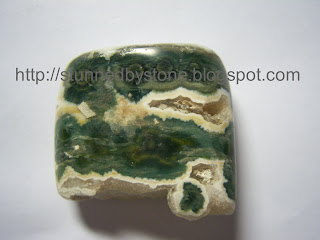 The colours are very intense on this piece, and there are even druses filled with quartz crystals!
 Check out the druse in the pic above!
 The colours are very intense on this piece, and there are even druses filled with quartz crystals!
 Check out the druse in the pic above!
Sunday, April 5, 2009
Wavellite
Wavellite gets its name from Named after William Wavell of England who discovered the mineral in a quarry in Devon, England in 1805.
Wavellite is a phosphate mineral, normally translucent green and can be found in fractures in aluminous metamorphic rock, in hydrothermal regions and in phosphate rock deposits.
Wavellite is a phosphate mineral, normally translucent green and can be found in fractures in aluminous metamorphic rock, in hydrothermal regions and in phosphate rock deposits.
I got these specimens from Kinokuniya, look at a close up picture, can you notice the circular habitat?
Saturday, April 4, 2009
Morganite
This is a beautiful specimen of the mineral beryl variety morganite.

Did you know that morganite is named after a financier (and gem and mineral collector) J. P. Morgan?
You can seen a beautiful gemmy crystal sitting in the middle of the matrix. Got this sample some years back when morganite was still pretty unheard of in Singapore.
A close up of the crystal:
Did you know that morganite is named after a financier (and gem and mineral collector) J. P. Morgan?
Wednesday, April 1, 2009
Smoky Quartz Cluster
This smoky quartz cluster was one of my first few quartz clusters that I owned.
 It has a nicely shaped crystals and a interesting habitat.

 It has a nicely shaped crystals and a interesting habitat.
Saturday, March 28, 2009
Chlorite in Quartz
This is a very interesting piece of chlorite in quartz specimen:

The layered inclusions on the face of the crystal look like that of a thumprint, check out the zoom up below:

Chlorite inclusions are very common in alpine-type environments, and generally occur in fissures and pockets inside igneous and metamorphic rocks, and in sedimentary rocks that are rich in clay minerals. "Chlorite" is actually the name for a group of phyllo-silicates (sheet-silicates), minerals of mica-like appearance. The name refers to the very common green color, although chlorite minerals do not have to be green.
Chlorite minerals form at low to moderate temperatures. Often quartz from alpine-type clefts has a chlorite "icing" on the crystal surface, giving them a rough and dull look, because the crystals started to grow at high temperatures, and when their growth slowed down at lower temperatures, chlorite formed in the pocket and settled on the crystal faces.
The layered inclusions on the face of the crystal look like that of a thumprint, check out the zoom up below:
Chlorite inclusions are very common in alpine-type environments, and generally occur in fissures and pockets inside igneous and metamorphic rocks, and in sedimentary rocks that are rich in clay minerals. "Chlorite" is actually the name for a group of phyllo-silicates (sheet-silicates), minerals of mica-like appearance. The name refers to the very common green color, although chlorite minerals do not have to be green.
Chlorite minerals form at low to moderate temperatures. Often quartz from alpine-type clefts has a chlorite "icing" on the crystal surface, giving them a rough and dull look, because the crystals started to grow at high temperatures, and when their growth slowed down at lower temperatures, chlorite formed in the pocket and settled on the crystal faces.
Thursday, March 26, 2009
Amethyst flowers
A gorgeous amethyst flower crystal, take a look does this really look like a boquet of flowers with the leaves?

 Amethyst flowers are a rare form of the mineral amethyst.
Unlike its deep, dark purple cousins, this piece demonstrate the diversity of amethyst in general, and the highly unique and rare character of this amethyst in particular. This gorgeous mineral is simply elegant!

 Amethyst flowers are a rare form of the mineral amethyst.
Unlike its deep, dark purple cousins, this piece demonstrate the diversity of amethyst in general, and the highly unique and rare character of this amethyst in particular. This gorgeous mineral is simply elegant!
Wednesday, March 25, 2009
Halite
This piece of halite (crystallized sodium chloride) has in my collection for nearly 8 years.

I have been keeping it in a air tight container as I feel that halite tends to be very hydroscopic... the humidity in the air would reduce it to a pool of salt in no time...

The mineral is typically colorless to yellow, but may also be light blue, dark blue, and pink depending on the amount and type of impurities. It commonly occurs with other evaporite deposit minerals such as several of the sulfates, halides and borates.
Unusual, purple, fibrous vein filling halite is found in France and a few other localities. Halite crystals termed hopper crystals appear to be "skeletons" of the typical cubes, with the edges present and stairstep depressions on, or rather in, each crystal face. In a rapidly crystallizing environment the edges of the cubes simply grow faster than the centers. Halite crystals form very quickly in some rapidly evaporating lakes resulting in modern artefacts with a coating or encrustation of halite crystals. Halite flowers are rare stalactites of curling fibers of halite that are found in certain arid caves of Australia's Nullarbor Plain. Halite stalactites and encrustations are also reported in the Quincy native copper mine of Hancock, Michigan.
I have been keeping it in a air tight container as I feel that halite tends to be very hydroscopic... the humidity in the air would reduce it to a pool of salt in no time...

The mineral is typically colorless to yellow, but may also be light blue, dark blue, and pink depending on the amount and type of impurities. It commonly occurs with other evaporite deposit minerals such as several of the sulfates, halides and borates.
Unusual, purple, fibrous vein filling halite is found in France and a few other localities. Halite crystals termed hopper crystals appear to be "skeletons" of the typical cubes, with the edges present and stairstep depressions on, or rather in, each crystal face. In a rapidly crystallizing environment the edges of the cubes simply grow faster than the centers. Halite crystals form very quickly in some rapidly evaporating lakes resulting in modern artefacts with a coating or encrustation of halite crystals. Halite flowers are rare stalactites of curling fibers of halite that are found in certain arid caves of Australia's Nullarbor Plain. Halite stalactites and encrustations are also reported in the Quincy native copper mine of Hancock, Michigan.
Wednesday, February 18, 2009
Dioptase
Late in the 18th century, copper miners in Kazakhstan thought they found an emerald deposit of their dreams. They found fantastic cavities in quartz veins in a limestone, filled with thousands of lustrous emerald-green transparent crystals. The crystals were dispatched to Moscow, Russia for analysis. However the mineral's inferior hardness of 5 compared with emerald's greater hardness of 8 easily distinguished it.
Later Fr. René Just Haüy (the famed French mineralogist) in 1797 determined that the enigmatic Kazakhstani mineral was new to science and named it dioptase (Greek, dia, "through" and optima, "vision"), alluding to the mineral's two cleavage directions that are visible inside unbroken crystals.
 This specimen of mine was obtained through a neighbourhood store at a price so low that its literally a steal!
Later Fr. René Just Haüy (the famed French mineralogist) in 1797 determined that the enigmatic Kazakhstani mineral was new to science and named it dioptase (Greek, dia, "through" and optima, "vision"), alluding to the mineral's two cleavage directions that are visible inside unbroken crystals.
 This specimen of mine was obtained through a neighbourhood store at a price so low that its literally a steal!
Tuesday, February 17, 2009
Celestine
Celestial looking... light sky blue..

Celestine is is a mineral consisting of strontium sulfate. The mineral is named for its occasional delicate blue color.
Celestine occurs as crystals, and also in compact massive and fibrous forms. It is mostly found in sedimentary rocks, often associated with the minerals gypsum, anhydrite, and halite.

The mineral is found worldwide, usually in small quantities. Pale blue crystal specimens are found in Madagascar.
Celestine is is a mineral consisting of strontium sulfate. The mineral is named for its occasional delicate blue color.
Celestine occurs as crystals, and also in compact massive and fibrous forms. It is mostly found in sedimentary rocks, often associated with the minerals gypsum, anhydrite, and halite.
The mineral is found worldwide, usually in small quantities. Pale blue crystal specimens are found in Madagascar.
Saturday, February 14, 2009
Enhydro Quartz Crystal
A big arrow is drawn on the face of this crystal?
Defacing the art of Mother Nature?
Not really... but rather the arrow marks the location of an important inclusion in this crystal! It is a Enhydro Quartz Crystal .
Defacing the art of Mother Nature?
Not really... but rather the arrow marks the location of an important inclusion in this crystal! It is a Enhydro Quartz Crystal .
 Technically speaking, an enhydro is "a hollow nodule or geode of chalcedony containing water, sometimes in large amounts" per the The American Geological Institute’s Glossary of Geological Terms. As such, these crystals are actually not enhydros but more accurately referred to as "quartz with bubble fluid inclusion".
These crystals formed millions of years ago (220-400 million years ago by some estimates) as the edges of the quartz formed faster than the center. As this happened, troughs were formed that trapped the water solution or other foreign matter. When these troughs were covered by more crystal growth, the captured water (sometimes salt water or other liquid) would "gas out" or cool and contract and a bubble would form in the liquid. Enhydro water bubble quartz is a true spectacle of nature. Being able to see gas bubbles move in solid rock that was formed millions , or perhaps even billions, of years ago is hard to imagine but enjoyable to watch!
Tuesday, October 7, 2008
Chlorite in Quartz
This polished quartz point has inclusions of green chlorite..
giving it the trade name of scenic quartz as the inclusions do form a design similar to 'scenic paintings'
Monday, October 6, 2008
Sceptre Quartz
No, it's not something obscene that I posted up today!
Rather, this is really a work done by Mother Nature and is known as Sceptre Quartz !


Rather, this is really a work done by Mother Nature and is known as Sceptre Quartz !


Doesnt it remind you of some phallic looking object?
Wednesday, August 13, 2008
Tourmaline on Quartz
Tourmaline on Quartz specimen..


The gemmy tourmaline crystal appears to be bicoloured and exhibits a range of green colours!


The gemmy tourmaline crystal appears to be bicoloured and exhibits a range of green colours!
Subscribe to:
Comments (Atom)